

A dog’s food requirement depends on more than body weight. Age, growth stage, activity, reproductive status, body condition, health, and the calorie density of the food can all affect how much food is appropriate.
This is why two dogs weighing the same amount can have different daily calorie requirements.
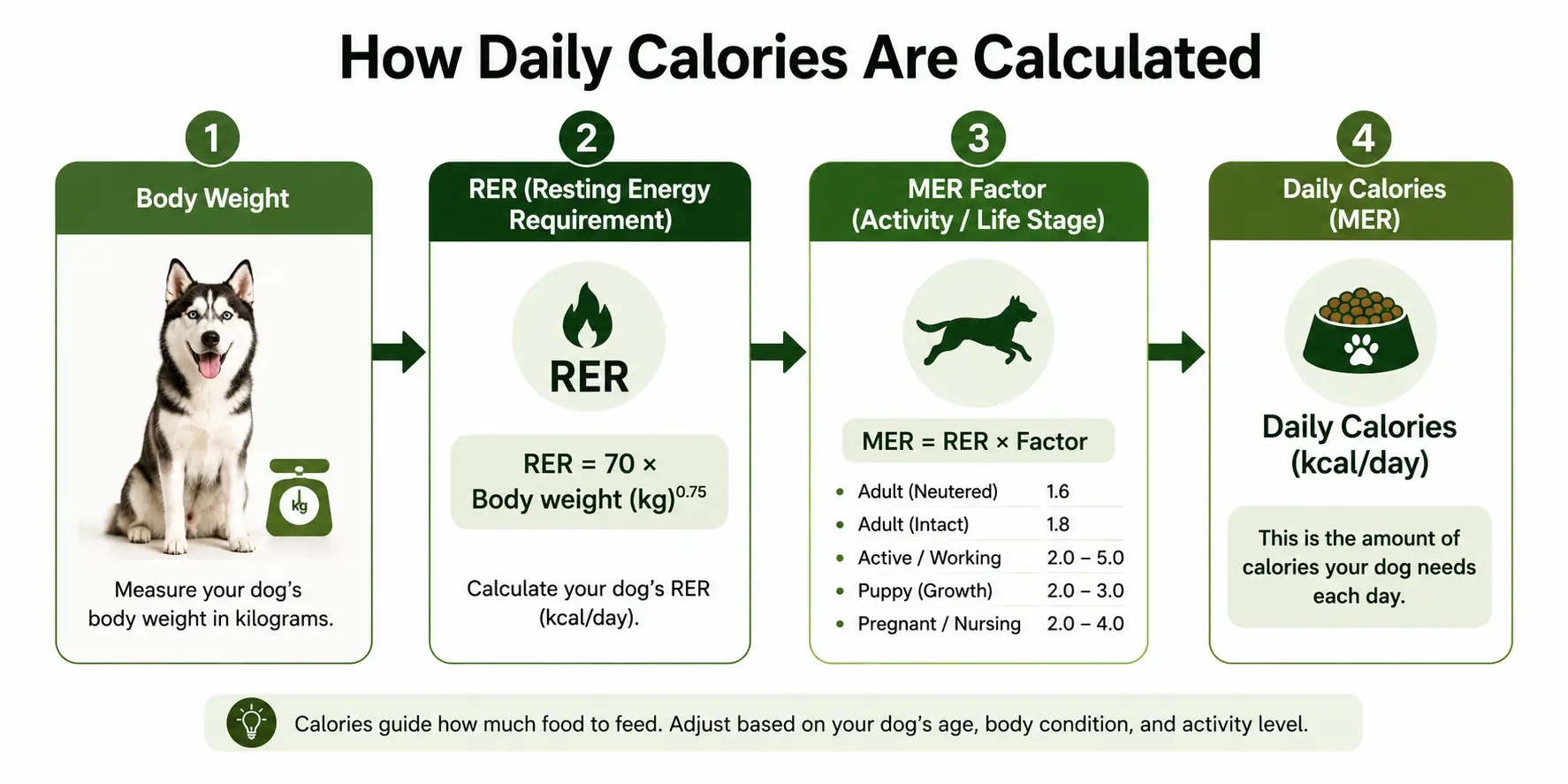
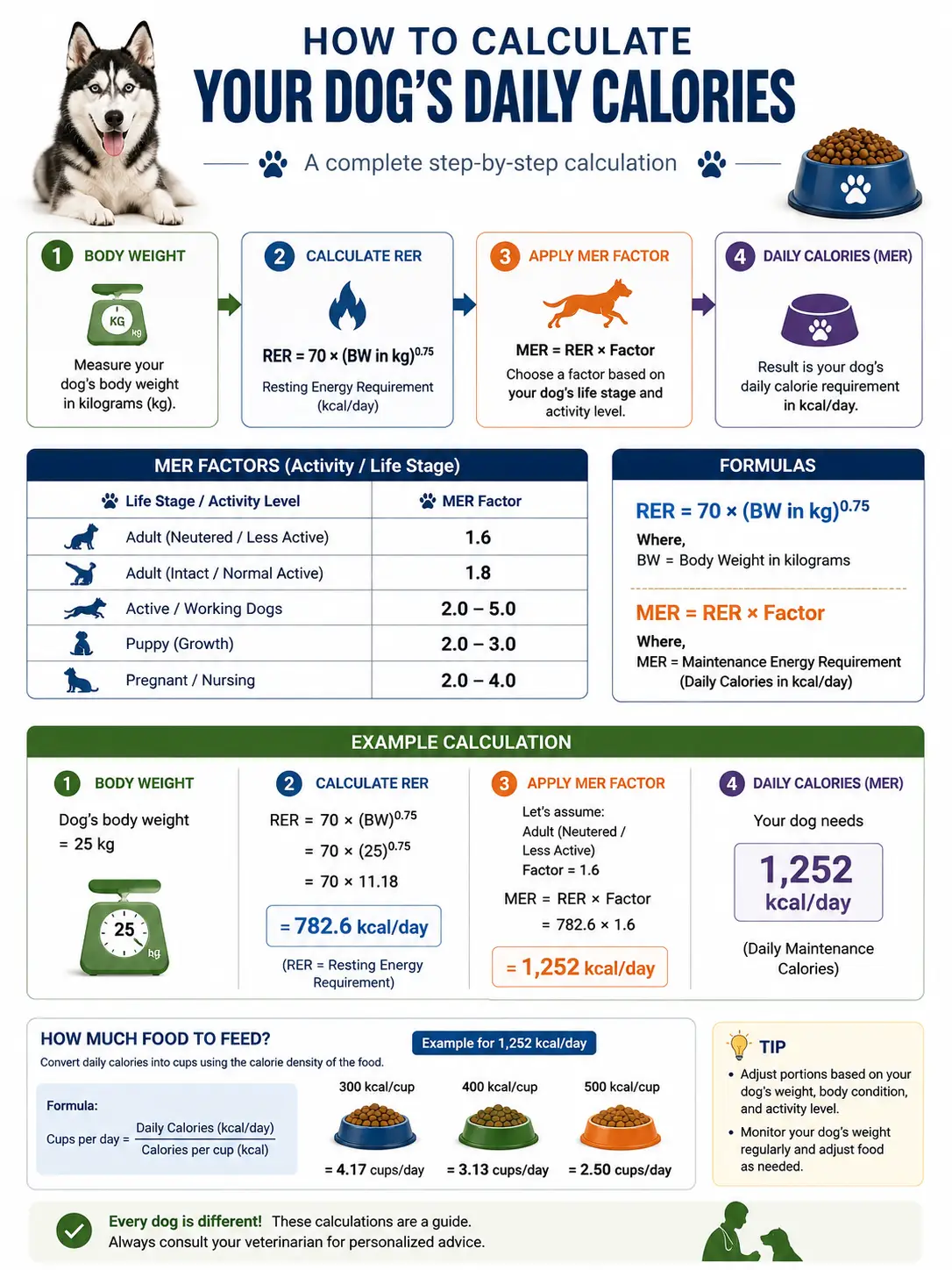
A useful starting point is to estimate the dog’s Resting Energy Requirement (RER) and then use a life-stage or activity factor to estimate Maintenance Energy Requirement (MER). The daily calorie estimate can then be converted into grams or cups using the calorie density of the actual food. AAHA uses this RER and MER approach in its canine nutrition guidelines.
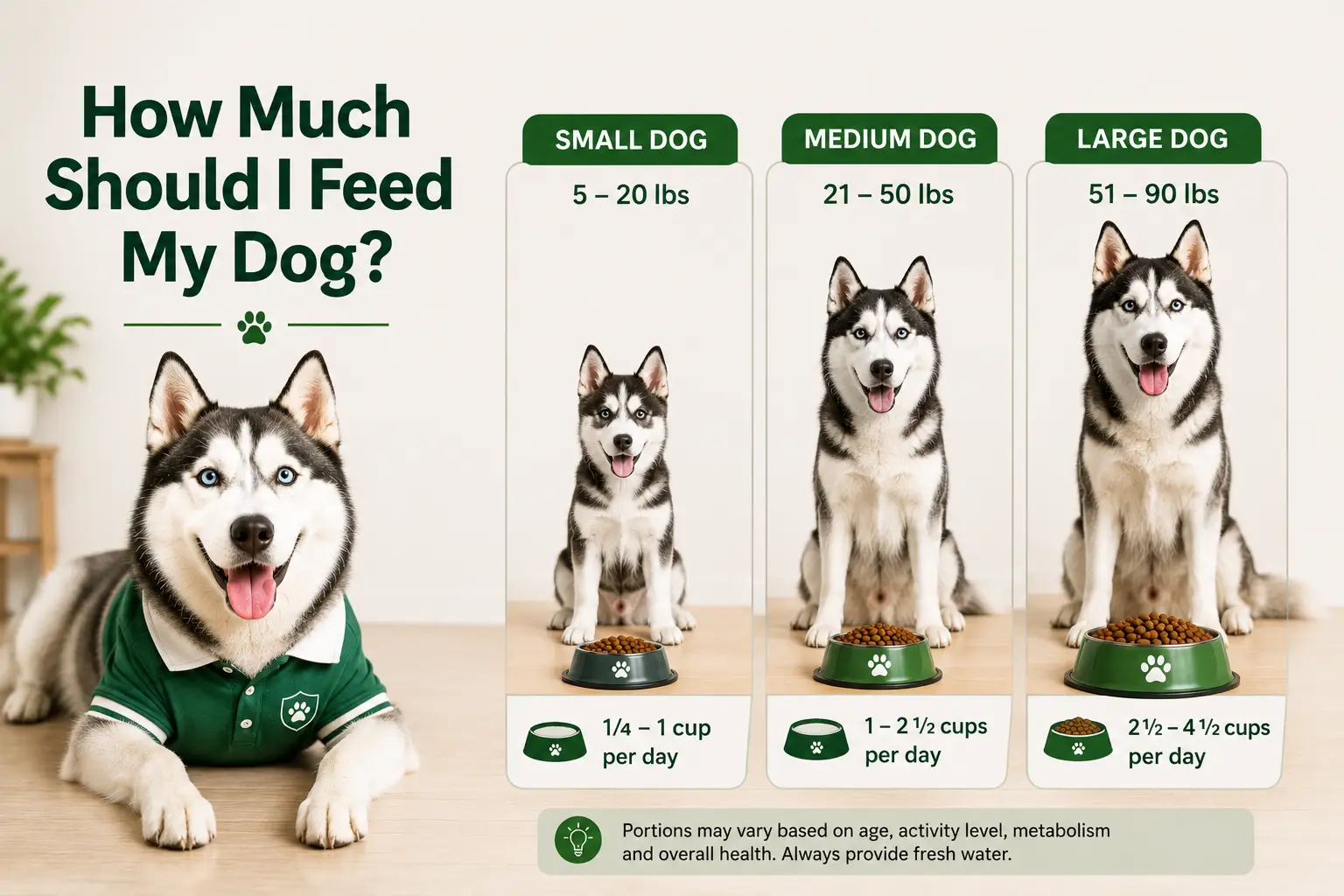
How Much Should I Feed My Dog?
There is no single number of cups that applies to every dog of a particular weight.
The calculation is:
RER = 70 × body weight in kg^0.75
Then:
MER = RER × appropriate life-stage or activity factor
Finally:
Food per day = daily calorie requirement ÷ calories per gram or cup of food
For example, if a dog needs an estimated 600 kcal per day and its food contains 400 kcal per cup:
600 ÷ 400 = 1.5 cups per day
The same dog would need a different number of cups if the food contained 300 or 500 kcal per cup.
AAHA describes these formulas and factors as general guidelines. Actual intake should be adjusted by monitoring body weight and body condition.
WSAVA Reference Chart: Daily Calories by Weight
The following chart gives starting calorie ranges for average healthy adult dogs in ideal body condition. The ranges are published by the WSAVA Global Nutrition Committee, which lists the 2006 NRC daily maintenance energy requirements as its reference calculation. They are not individual prescriptions.
This chart is a published reference table rather than a calculation. Further down, this article also shows how to work out a requirement from RER and an AAHA life-stage factor. The two approaches do not always produce the same range for the same dog, and the section below explains why.
| Dog Weight | Approx. Weight | Daily Calories | Example Cups at 400 kcal/cup |
|---|---|---|---|
| 2 kg | 4.4 lb | 140 to 177 kcal | 0.35 to 0.44 cup |
| 5 kg | 11 lb | 280 to 351 kcal | 0.70 to 0.88 cup |
| 10 kg | 22 lb | 470 to 590 kcal | 1.18 to 1.48 cups |
| 15 kg | 33 lb | 640 to 800 kcal | 1.60 to 2.00 cups |
| 20 kg | 44 lb | 790 to 993 kcal | 1.98 to 2.48 cups |
| 25 kg | 55 lb | 940 to 1,174 kcal | 2.35 to 2.94 cups |
| 30 kg | 66 lb | 1,080 to 1,346 kcal | 2.70 to 3.37 cups |
| 35 kg | 77 lb | 1,210 to 1,511 kcal | 3.03 to 3.78 cups |
| 40 kg | 88 lb | 1,340 to 1,670 kcal | 3.35 to 4.18 cups |
| 45 kg | 99 lb | 1,460 to 1,824 kcal | 3.65 to 4.56 cups |
| 50 kg | 110 lb | 1,590 to 1,970 kcal* | 3.98 to 4.93 cups* |
| 60 kg | 132 lb | 1,780 to 2,220 kcal* | 4.45 to 5.55 cups* |
* Values above 49 kg are extrapolated estimates based on the WSAVA table’s published calorie relationship rather than directly listed values. The WSAVA chart itself provides values through 49 kg.
Important: The cup column assumes a hypothetical food containing 400 kcal per cup. It is included to demonstrate the calculation. Your dog’s actual food may contain a different number of calories per cup.
WSAVA specifically notes that these calorie ranges are guidance for average healthy adult dogs in ideal body condition and that individual dogs can require higher or lower amounts to maintain an ideal body condition.
Why the Chart Gives a Range
A feeding chart that gives one exact number for every dog can create a false sense of precision.
For example, WSAVA lists approximately 470 to 590 kcal per day for a 10 kg healthy adult dog. That is a difference of 120 kcal per day despite the dogs having the same body weight.
The range reflects normal variation between individual dogs.
The calorie requirement should therefore be treated as a starting point and interpreted alongside body condition, activity, and actual food intake.
Why Two Reputable Sources Can Give Different Numbers
Veterinary references do not all use the same starting factors, so two reliable sources can give different answers for the same dog. Take a 20 kg neutered adult dog. Its resting energy requirement is 70 × 20^0.75, which is approximately 662 kcal per day. From that same figure:
- WSAVA reference chart: 790 to 993 kcal/day
- AAHA factor method (1.4 to 1.6 × RER): 927 to 1,059 kcal/day
- Merck Veterinary Manual (1.6 × RER for a neutered adult): approximately 1,059 kcal/day
Taken together that is a starting range of roughly 790 to 1,059 kcal per day. None of these is the single correct answer for an individual dog. They differ because they were built for slightly different purposes: a published reference table describing average healthy adults, and factor ranges intended to be applied by a clinician alongside the individual patient.
The differences are not limited to neutered adults. For an inactive or obesity-prone dog, AAHA gives a factor of 1.0 to 1.2 × RER, while the Merck Veterinary Manual lists 1.4 × RER, a figure above the whole AAHA range. Where reputable sources differ like this, the practical approach is to start somewhere within the range, weigh the dog every two to four weeks, and let body condition and the weight trend correct the number rather than trusting any single calculated figure.
How Much Food Does My Dog Need?
The amount of food your dog needs can be calculated in three stages:
- Estimate calorie requirements.
- Determine the calorie density of the food.
- Convert calories into grams or cups.
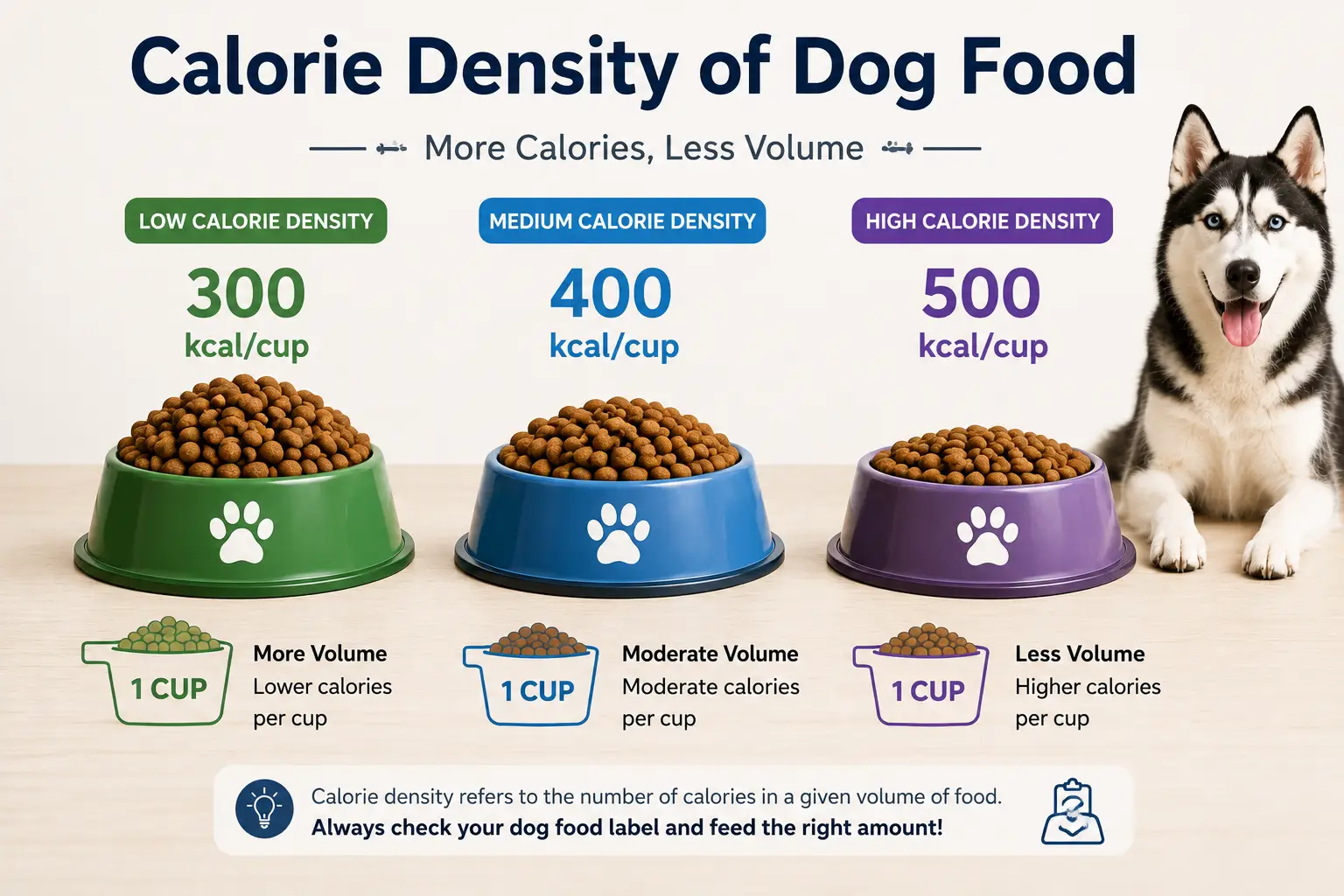
The important distinction is between calories and volume.
A cup is a measure of volume. It does not tell you how many calories the dog is consuming unless the calorie density of the food is known.
For example:
Food A
300 kcal/cup
A dog requiring 600 kcal would need:
600 ÷ 300 = 2 cups
Food B
400 kcal/cup
The same dog would need:
600 ÷ 400 = 1.5 cups
Food C
500 kcal/cup
The same dog would need:
600 ÷ 500 = 1.2 cups
The calorie requirement has not changed. Only the calorie density of the food has changed.
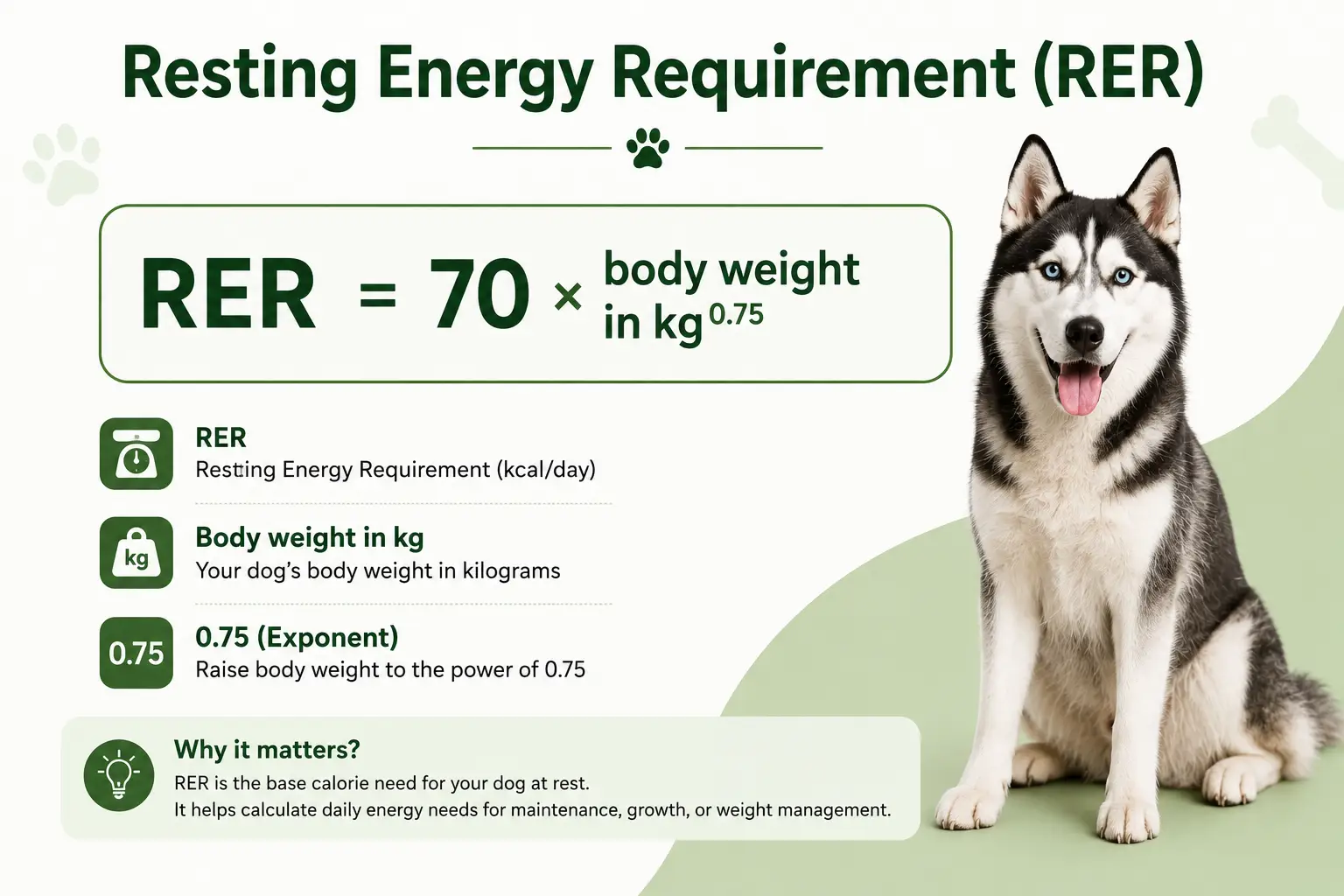
What Is RER?
RER stands for Resting Energy Requirement.
It is an estimate of the energy required to support basic physiological functions at rest.
The commonly used canine formula is:
RER = 70 × body weight in kg^0.75
AAHA uses this equation in its nutrition and weight management guidelines.
RER is not automatically the amount of food a healthy adult dog should receive each day.
A dog normally needs energy for movement, digestion, thermoregulation, growth, reproduction, work, and other daily functions.
That is why an additional calculation follows RER.
The Merck Veterinary Manual also lists a linear alternative: RER = (30 × body weight in kg) + 70. Merck states that this version applies to animals weighing more than 2 kg and less than 45 kg. Inside that band the two equations agree closely in the middle and drift apart towards the edges: for a 10 kg dog they give approximately 394 and 370 kcal, a difference of about 6%, while at 45 kg they give approximately 1,216 and 1,420 kcal, a difference of nearly 17%. This article uses the 70 × body weight in kg^0.75 equation throughout, because it applies at any body weight.
What Is MER?
MER stands for Maintenance Energy Requirement.
MER estimates the daily energy requirement after accounting for the dog’s life stage or other relevant factors.
The basic formula is:
MER = RER × life-stage or activity factor
AAHA provides different factors for dogs depending on circumstances such as neuter status, activity, growth, weight management, pregnancy, lactation, and work.
Some of the canine factors listed by AAHA are:
| Dog Category | General Factor |
|---|---|
| Neutered adult | 1.4 to 1.6 × RER |
| Intact adult | 1.6 to 1.8 × RER |
| Inactive or obesity-prone | 1.0 to 1.2 × RER |
| Weight loss | 1.0 × RER |
| Puppy under 4 months | 3.0 × RER |
| Puppy 4 months or older | 2.0 × RER |
| Pregnancy, final 21 days | 3.0 × RER |
| Light work | 1.6 to 2.0 × RER |
| Moderate work | 2.0 to 5.0 × RER |
| Heavy work | 5.0 to 11.0 × RER |
AAHA also lists a factor for lactation of 3.0 to 6.0 or more × RER. This range is unusually wide because energy needs during lactation change substantially over the nursing period, and the sources used here do not break the figure down by stage of lactation or litter size. A calculated number is not a reliable guide in this situation, and feeding a lactating dog is better planned with a veterinarian.
These factors are general starting guidelines. AAHA notes that sedentary or indoor pets may require less than the calculated factor suggests, and calorie intake should be adjusted using body weight and body condition.
RER Example: A 10 kg Dog
Suppose a dog weighs 10 kg.
First calculate:
RER = 70 × 10^0.75
10^0.75 is approximately 5.62.
Therefore:
RER = 70 × 5.62
RER ≈ 394 kcal/day
The dog’s estimated resting energy requirement is therefore approximately 394 kcal per day.
This is not yet the final daily feeding amount.
MER Example: A 10 kg Neutered Adult Dog
Using the same 10 kg dog:
RER ≈ 394 kcal/day
AAHA gives a general factor of 1.4 to 1.6 × RER for neutered adult dogs.
Using 1.4:
394 × 1.4 = 552 kcal/day
Using 1.6:
394 × 1.6 = 630 kcal/day
That produces a starting estimate of approximately:
552 to 630 kcal/day
This illustrates why an exact calorie requirement cannot be determined from weight alone.
How Many Cups of Food Should I Feed My Dog?
Once the daily calorie requirement has been estimated, convert it into a food portion.
The formula is:
Cups per day = daily calorie requirement ÷ kcal per cup
Suppose the estimated requirement is 600 kcal/day.
If the food contains 400 kcal/cup:
600 ÷ 400 = 1.5 cups/day
If the food contains 350 kcal/cup:
600 ÷ 350 = 1.71 cups/day
If the food contains 450 kcal/cup:
600 ÷ 450 = 1.33 cups/day
Therefore, the answer to “how many cups should I feed my dog?” requires the calorie density of the specific food.
Where to Find Your Food’s Calorie Content
Every portion calculation depends on the calorie density of the specific food, so it is worth knowing where that number sits on the bag. Look for a panel headed Calorie Content. Under AAFCO’s model regulations it is printed separately from the Guaranteed Analysis, which lists protein, fat, fibre and moisture percentages rather than calories, so the two are easy to confuse. The calorie content statement is given as kilocalories of metabolisable energy per kilogram of food as fed, and also per familiar household measure such as per cup, per can or per biscuit.
Use the per-cup figure if you measure with a cup, and the per-kilogram figure if you weigh the food. A small number of older products still on shelves predate the requirement and may not carry the statement; the manufacturer can usually supply it on request.
How to Calculate Food in Grams
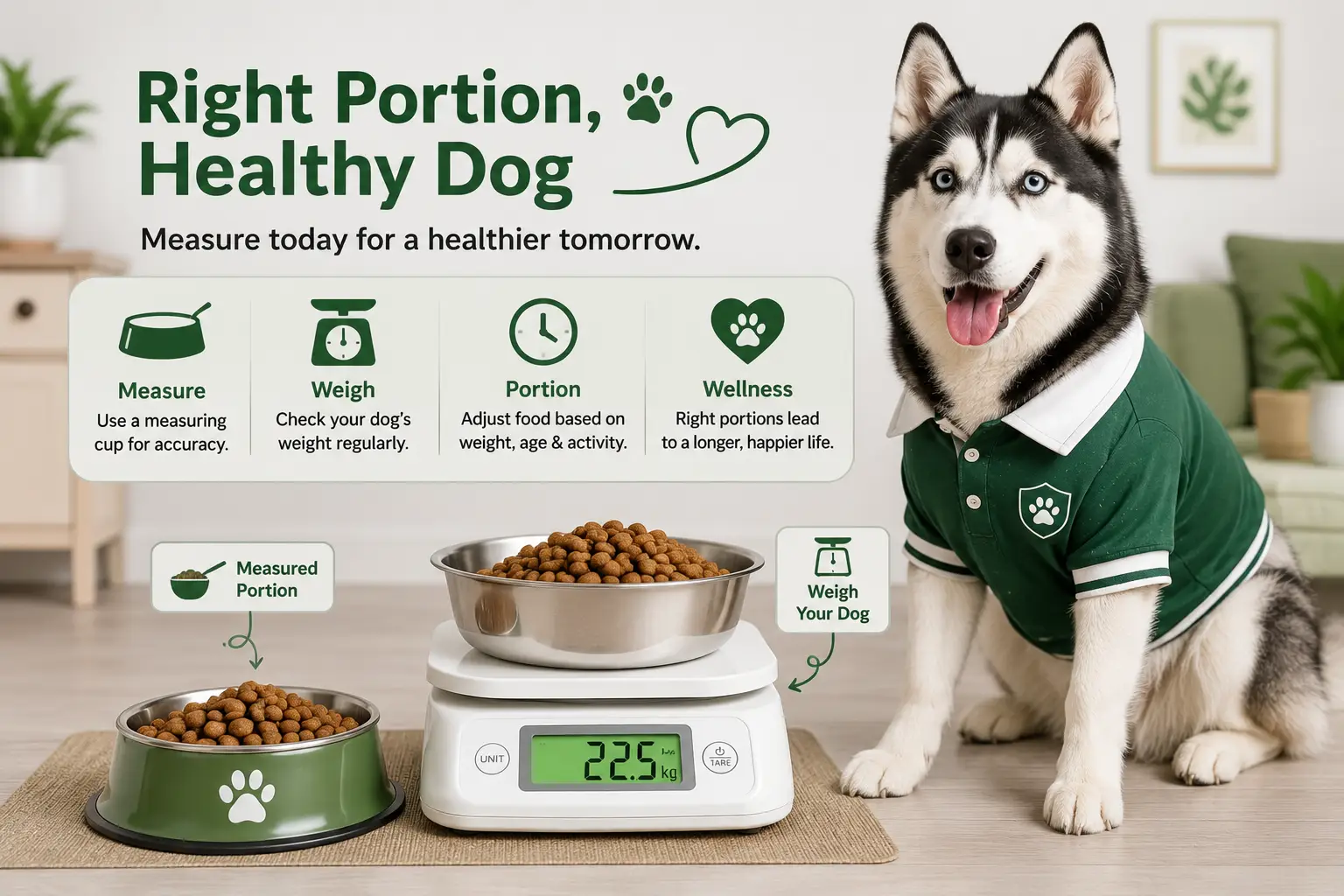
Measuring food by weight can make portions more consistent than using a measuring cup.
AAHA identifies weighing food with a gram scale as a way to improve precision and accuracy compared with measuring cups.
Suppose a food contains:
3.5 kcal per gram
And the dog’s estimated daily requirement is:
700 kcal
The calculation is:
700 ÷ 3.5 = 200 grams/day
The daily amount would therefore be approximately 200 grams.
If feeding twice a day:
100 g in the morning + 100 g in the evening
The exact amount should still be adjusted according to the dog’s body condition and individual response.
How Much Should I Feed a Puppy?
Puppies have different energy requirements from adult dogs because they are growing.
AAHA lists a general factor of:
- 3 × RER for puppies under 4 months
- 2 × RER for puppies 4 months and older
Growth requirements also change as the puppy approaches adult size.
AAHA’s canine feeding guidance describes approximately:
- 3 × RER from weaning until around 50% of expected adult body weight
- 2.5 × RER from around 50% to 80% of expected adult body weight
- 1.8 to 2.0 × RER once the puppy reaches at least 80% of expected adult body weight
These figures illustrate why puppy feeding cannot be determined from age alone.
Expected adult size and current growth stage also matter.
Puppy example
Suppose a puppy weighs 5 kg.
RER:
70 × 5^0.75 ≈ 234 kcal/day
If the puppy is under 4 months and the 3 × RER factor is used as a starting estimate:
234 × 3 = 702 kcal/day
If the food contains 400 kcal/cup:
702 ÷ 400 = 1.76 cups/day
This is a calculation example rather than a fixed feeding prescription for every 5 kg puppy.
Growing puppies need regular monitoring because their requirements change as their body size and growth stage change.
How Much Should I Feed an Adult Dog?
Healthy adult dogs have lower energy requirements than growing puppies in many cases, but adult requirements still vary considerably.
Factors include:
- Body weight
- Activity level
- Neuter status
- Body condition
- Lifestyle
- Breed and individual variation
- Health status
- Food calorie density
AAHA gives a general factor of 1.4 to 1.6 × RER for neutered adult dogs and 1.6 to 1.8 × RER for intact adult dogs. Inactive or obesity-prone dogs have a lower general factor range.
The WSAVA adult calorie chart also demonstrates variation within the same body weight.
How Much Should I Feed a Senior Dog?
Senior dogs do not automatically require a specific percentage reduction in food.
Energy requirements generally decrease over a dog’s lifetime, but the change varies between individual dogs. Older dogs may also experience changes in muscle mass, body condition, activity, appetite, or health.
For a senior dog, monitoring should include:
- Body weight
- Body condition
- Muscle condition
- Appetite
- Activity
- Changes in body shape
- Existing health conditions
A senior dog that becomes less active may need fewer calories, while a dog experiencing unwanted weight or muscle loss may require a different nutritional approach.
Should I Feed My Dog Once or Twice a Day?
For many adult dogs, dividing the daily food allowance into two meals provides a straightforward feeding routine.
For example, if the calculated daily amount is:
2 cups/day
It can be divided into:
1 cup in the morning
and
1 cup in the evening
The important calculation is the total daily amount.
Puppies generally need more frequent meals when they are young, with feeding frequency changing as they mature.
The appropriate schedule can also depend on health conditions, medications, activity, household routine, and veterinary recommendations.
Should I Follow the Dog Food Bag Feeding Chart?
The feeding directions on a commercial dog food package can be used as a starting point.
They should not necessarily be treated as an individualized feeding prescription.
AAHA notes that commercial feeding recommendations can sometimes overestimate energy requirements and recommends monitoring body weight and body condition when determining whether the amount being fed is appropriate.
A practical approach is:
Food label → calorie information → estimated calorie requirement → measured portion → body-condition monitoring
If the dog maintains an appropriate body condition, the feeding amount may be appropriate. If weight or body condition changes unexpectedly, the feeding plan may need adjustment.
How Do I Know If I Am Feeding Too Much?
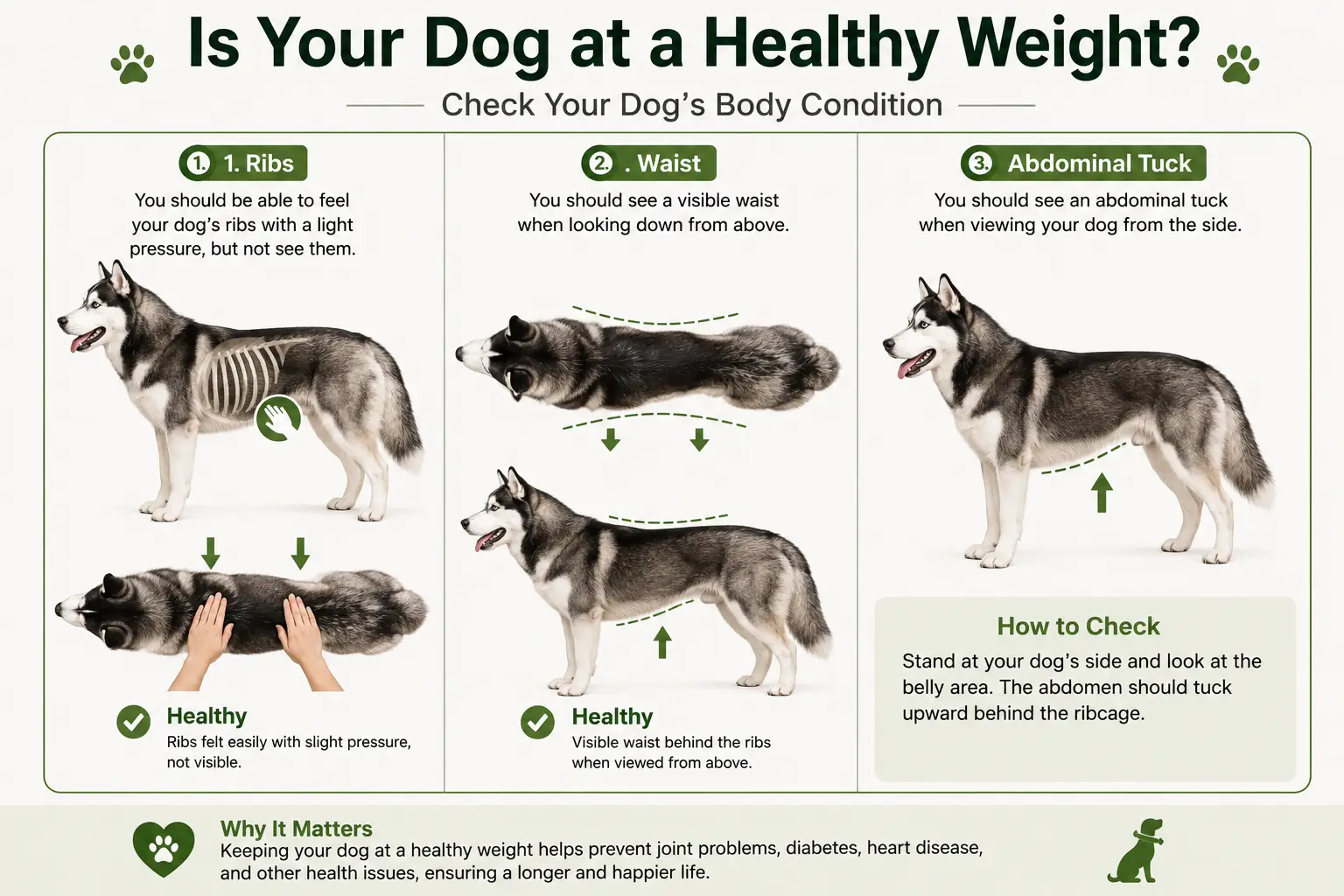
Body condition provides information that a feeding calculation alone cannot provide. It is important to understand the complete dog care information.
Signs that may indicate excess body fat include:
- Ribs becoming difficult to feel
- Reduced waist definition
- Increasing abdominal fat
- Gradual weight gain
- Reduced mobility or activity
AAHA uses body condition scoring as part of nutritional assessment and identifies approximately 4.5 to 5 out of 9 as an ideal body condition range for many dogs.
A calorie calculation should therefore be viewed as a starting estimate.
The practical cycle is:
Calculate → Feed → Monitor → Adjust
How Do I Know If I Am Feeding Too Little?
Possible signs include:
- Unintended weight loss
- Loss of muscle
- Poor body condition
- Persistent reduction in body weight
- Reduced energy
- Visible ribs or other bony structures beyond what is expected for the dog’s body type
However, unexplained weight loss should not automatically be attributed to insufficient food.
Dental disease, gastrointestinal problems, endocrine disorders, chronic disease, parasites, and other conditions can affect weight and appetite.
A significant or unexplained change in weight warrants veterinary evaluation.
Dog Feeding and Treat Calories
Treats, snacks, toppers, table food, chews, and supplements can contribute calories to the daily intake.
AAHA recommends keeping treats and other additional food items at 10% or less of total daily calorie intake so that the main complete and balanced diet remains the primary source of nutrition.
For example, if a dog consumes approximately:
700 kcal/day
10% would be:
70 kcal
If the dog receives 70 kcal from treats, those calories form part of the daily intake rather than being additional calories on top of the calculated requirement.
This is particularly relevant when treats are given several times throughout the day.
Why Measuring Cups Can Be Inaccurate
Two cups of the same food should theoretically contain the same amount of food, but household measuring can introduce variation.
For example:
- A cup can be overfilled.
- Kibble can settle differently.
- Different kibble shapes have different densities.
- A person may use a heaped rather than level cup.
- Different foods contain different calories per cup.
A gram scale measures the actual mass of food and can provide greater consistency. AAHA specifically lists weighing food as a method to improve feeding precision.
For dogs whose weight needs close monitoring, weighing food can therefore be useful.
What About an Overweight Dog?
Weight management uses a different approach from simply applying a standard adult feeding chart.
AAHA’s weight management guidance recommends basing calculations on ideal body weight in overweight dogs and adjusting intake according to the individual response.
The AAHA table lists:
Weight loss = 1.0 × RER
as a general canine factor.
However, calorie restriction should also consider the nutritional adequacy of the diet. AAHA notes that therapeutic weight-loss diets may be preferred when substantial calorie restriction is required because they are formulated to provide appropriate nutrient concentrations at reduced calorie intake.
A dog that needs to lose weight should therefore not simply be given an arbitrarily small amount of its normal food.
What About Very Active or Working Dogs?
Activity can have a substantial effect on calorie requirements.
AAHA lists general canine work factors of:
- Light work: 1.6 to 2.0 × RER
- Moderate work: 2.0 to 5.0 × RER
- Heavy work: 5.0 to 11.0 × RER
The wide ranges reflect the fact that “active dog” is not a precise nutritional category.
A dog that takes two daily walks is different from a dog performing sustained physical work.
For active dogs, food intake should be considered alongside the actual workload, body condition, weight changes, and recovery.
A Simple Dog Feeding Calculation
Here is the complete process in one example.
Dog
- Weight: 20 kg
- Life stage: adult
- Status: neutered
- Food: 400 kcal/cup
Step 1: Calculate RER
RER = 70 × 20^0.75
20^0.75 is approximately 9.46.
Therefore:
RER ≈ 662 kcal/day
Step 2: Apply the adult factor
AAHA gives 1.4 to 1.6 × RER as a general starting factor for neutered adult dogs.
Lower estimate:
662 × 1.4 = 927 kcal/day
Upper estimate:
662 × 1.6 = 1,059 kcal/day
Step 3: Convert calories into cups
At 400 kcal/cup:
927 ÷ 400 = 2.32 cups
and:
1,059 ÷ 400 = 2.65 cups
The calculated starting range is therefore approximately:
2.3 to 2.7 cups/day
This range is then interpreted using the dog’s body condition, activity, actual food intake, and weight trend.
The Formula in One Place
For readers who want the complete calculation:
1. Convert pounds to kilograms
kg = pounds ÷ 2.205
2. Calculate RER
RER = 70 × kg^0.75
3. Estimate MER
MER = RER × appropriate factor
4. Convert calories to grams
grams/day = MER ÷ kcal per gram
5. Convert calories to cups
cups/day = MER ÷ kcal per cup
6. Divide the daily amount between meals
For two meals:
Meal amount = daily amount ÷ 2
These equations allow the same calculation to be applied to different dog weights and different foods.
How Far Can an Individual Dog Be From the Calculated Number
Calculated requirements describe averages, and individual dogs sit around that average rather than exactly on it. The Merck Veterinary Manual puts the size of that spread directly: “any given animal may require as much as 30% more or less of the calories calculated for its body weight than another animal with the same body weight.” In other words, two dogs of the same weight can genuinely need noticeably different amounts. A calculated figure is therefore a starting point for the first few weeks rather than a target to defend: weigh the dog, check body condition, and let the weight trend correct the number.
Dog Feeding Chart: Important Limitations
A dog feeding chart by weight is useful for estimating a starting range, but it has several limitations.
Weight does not tell the whole story
Two dogs of the same weight can have different calorie requirements.
Age changes requirements
Puppies have growth requirements, while senior dogs may experience changes in energy needs.
Food density changes portions
A 400 kcal/cup food and a 500 kcal/cup food cannot be fed in the same cup quantity if the calorie target is the same.
Body condition matters
A dog at an ideal body condition and a dog carrying excess body fat should not necessarily receive the same calorie target.
Activity matters
Working and highly active dogs can have substantially different energy requirements from sedentary dogs.
For these reasons, the chart should be used as a starting reference rather than an exact feeding prescription.
Printable Dog Feeding Chart
For a printable version, the following information can be placed on a one-page reference sheet:
| Weight | Approx. Daily Calories for an Average Healthy Adult Dog | Cups at 400 kcal/cup |
|---|---|---|
| 2 kg / 4.4 lb | 140 to 177 kcal | 0.35 to 0.44 |
| 5 kg / 11 lb | 280 to 351 kcal | 0.70 to 0.88 |
| 10 kg / 22 lb | 470 to 590 kcal | 1.18 to 1.48 |
| 15 kg / 33 lb | 640 to 800 kcal | 1.60 to 2.00 |
| 20 kg / 44 lb | 790 to 993 kcal | 1.98 to 2.48 |
| 25 kg / 55 lb | 940 to 1,174 kcal | 2.35 to 2.94 |
| 30 kg / 66 lb | 1,080 to 1,346 kcal | 2.70 to 3.37 |
| 35 kg / 77 lb | 1,210 to 1,511 kcal | 3.03 to 3.78 |
| 40 kg / 88 lb | 1,340 to 1,670 kcal | 3.35 to 4.18 |
| 45 kg / 99 lb | 1,460 to 1,824 kcal | 3.65 to 4.56 |
Formula reminder:
RER = 70 × kg^0.75
MER = RER × life-stage/activity factor
Food amount = daily calories ÷ food calorie density
The chart can be offered as a printable PDF reference alongside the article.
Frequently Asked Questions
How much food should a dog eat per day?
The amount depends on the dog’s calorie requirement and the calorie density of its food. RER can be calculated using 70 × kg^0.75, followed by an appropriate MER factor. The resulting calorie estimate can then be converted into grams or cups using the food’s calorie density.
How many cups of food should I feed my dog?
There is no universal cup amount for each body weight. The correct number depends on the calories per cup of the food.
The calculation is:
Cups/day = daily calorie requirement ÷ kcal per cup
For example, a dog requiring 800 kcal/day would need 2 cups of a 400 kcal/cup food.
How do I calculate my dog’s calorie needs?
Start with:
RER = 70 × body weight in kg^0.75
Then:
MER = RER × appropriate life-stage or activity factor
For example, a 10 kg dog has an RER of approximately 394 kcal/day. Applying AAHA’s general 1.4 to 1.6 factor for a neutered adult gives an illustrative range of approximately 552 to 630 kcal/day.
Should I feed my dog once or twice a day?
Many adult dogs can have their daily food divided into two meals. Puppies generally require more frequent meals when young. Feeding frequency can also depend on health, medications, activity, and individual circumstances.
Should I follow the feeding instructions on the food package?
Package instructions provide a starting point, but they may not account for the individual dog’s activity, body condition, or calorie needs. AAHA recommends assessing body weight and body condition and adjusting feeding when necessary.
Is it better to measure dog food by cups or grams?
Weighing food in grams can provide greater consistency than measuring cups. AAHA specifically identifies gram-scale weighing as a way to improve precision and accuracy.
Do treats count toward daily calories?
Yes. Treats and other additional foods contribute calories. AAHA recommends keeping treats and other additional food items at no more than 10% of total daily calorie intake.
How much should I feed an overweight dog?
Weight-loss feeding should generally be based on an appropriate target or ideal body weight rather than simply applying the standard adult feeding chart to the dog’s current weight. AAHA lists 1.0 × RER as a general canine weight-loss factor and recommends monitoring and adjusting the plan.
Do puppies need more food than adult dogs?
Puppies generally have higher energy requirements relative to their size because they are growing. AAHA lists 3 × RER for puppies under 4 months and 2 × RER for puppies 4 months and older as general starting factors.
Do senior dogs need less food?
Energy requirements generally decrease over a dog’s lifetime, but the amount varies between individuals. Senior dogs should also be monitored for changes in body condition and muscle condition.
Final Takeaway
The answer to “how much should I feed my dog?” starts with calories rather than cups.
The basic calculation is:
RER = 70 × body weight in kg^0.75
Then:
MER = RER × appropriate life-stage or activity factor
Then:
Daily food amount = MER ÷ food calorie density
For example, if the estimated requirement is 600 kcal per day and the food contains 400 kcal per cup:
600 ÷ 400 = 1.5 cups per day
The same calorie requirement would produce a different portion if the food had a different calorie density.
A feeding chart can provide a useful starting point, but the dog’s age, growth stage, activity, reproductive status, body condition, health, and actual response to the diet also need to be considered.
The practical process is:
Calculate → Measure → Monitor → Adjust
AAHA describes nutritional assessment as an individualized process and recommends monitoring body weight and body condition rather than relying on a calculation alone.
Last reviewed: August 2026
This article is for general educational information. Dogs with obesity, unexplained weight loss, pregnancy, lactation, growth concerns, chronic disease, or other specific nutritional needs may require an individualized feeding plan.
Everything on this page is an estimated daily energy requirement rather than the exact amount a particular dog should eat. If your dog is pregnant or lactating, is significantly over or under weight, has a diagnosed medical condition, or is on a prescription diet, these figures are the wrong starting point and the plan should come from your veterinarian.